

Sexual Abuse and Assault Injury Lawyers


Diocese of Lansing Sexual Abuse Allegations
Despite its contributions to the community, the Diocese of Lansing sexual abuse allegations involving clergy members, with cases spanning decades, have tarnished its reputation.
For survivors seeking justice, Injury Lawyer Team provides experienced legal representation, helping individuals hold perpetrators and institutions accountable. With a deep understanding of the sensitive nature of these cases, our Michigan clergy abuse attorney team is dedicated to securing justice and compensation for survivors.
Background and Influence of the Catholic Diocese of Lansing
The Diocese of Lansing was established in 1937 to serve the spiritual needs of Catholics in Michigan, encompassing parishes, schools, and charitable organizations across the region. With St. Mary Cathedral in downtown Lansing as its spiritual center, the diocese has long been a cornerstone of religious life for over 200,000 Catholics.
The diocese’s history is deeply rooted in the growth of Catholicism in Michigan, with its outreach extending to rural areas, urban centers like Jackson, Flint, and Ann Arbor, and educational institutions across the state.
Through its network of Catholic high schools, elementary schools, and charities, the diocese has not only served as a spiritual guide but also contributed significantly to education and social welfare.
The late Bishop Kenneth Povish and subsequent bishops have shaped the diocese’s trajectory, emphasizing community engagement and faith-driven education. Leaders of the Diocese of Lansing have often been prominent figures in Michigan’s religious and cultural dialogues, influencing policies on topics like gender identity and Catholic education.
However, the diocese’s prominence has also brought scrutiny, particularly regarding its handling of clerical sexual abuse allegations. Some clergy accused of misconduct served in major parishes and institutions, with survivors reporting abuse during Catholic church services, youth programs, and schools overseen by the diocese.
While the Diocese of Lansing has implemented reforms to address past failings, including policies for mandatory reporting and enhanced background checks for clergy, many survivors and advocates remain critical of the diocese’s historical handling of abuse allegations.
The diocese continues to face calls for greater transparency and accountability, as faith in its leadership remains strained among some Catholics.
Despite these challenges, the diocese remains a central figure in Michigan’s religious life, with many parishioners staying connected through platforms like Faith Magazine, Catholic Charities, and other diocesan publications and services.
Clergy Sexual Abuse Allegations Within the Diocese of Lansing
The Diocese of Lansing has faced numerous allegations of abuse involving clergy members, with reports spanning several decades. Reports indicate that many victims were minors involved in parish activities, including altar servers, students at Catholic schools, and participants in youth programs.
Lansing Diocese Clergy Accused of Sexual Abuse of Minors
The list of Michigan priests accused of sexual misconduct in the Diocese of Lansing includes:
- Fr. Joseph Emile Aubin
- Fr. James B. Bettendorf
- Fr. Alphonse Boardway
- Fr. Francis Gerald Boyer
- Fr. Kenneth F. Coughlin
- Fr. Timothy M. Crowley
- Fr. Vincent Anthony DeLorenzo
- Fr. Patrick W. Egan
- Fr. Alexander Thomas Fitzgerald
- Br. Jeffrey Gregory
- Fr. Paul James Guoan
- Fr. Michael Robert Kelly
- Fr. James William Lee, Jr.
- Fr. Marian John Lesniak
- Fr. Richard Lobert
- Fr. Shaun D. Lowery
- Fr. John Edward Martin
- Fr. Joseph McHugh
- Fr. James M. Novak
- Fr. John Donald Slowey
- Bishop James S. Sullivan
- Fr. Edgar Szymanski
- Fr. Chester Vincent Tomaszewski
- Fr. Darius W. Wyszynski
Attorney General’s and Police Investigation into the Diocese of Lansing
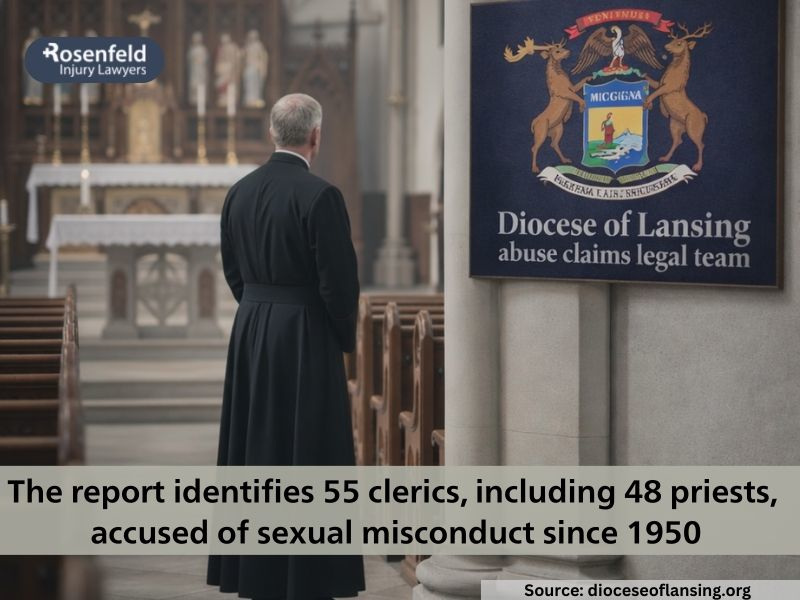
The Attorney General’s office released a detailed report in December 2024, naming over 30 priests from the Diocese of Lansing with credible allegations of sexual misconduct, leading to various criminal and civil legal actions. Some of them include:
- A man publicly alleged that Fr. Alphonse Boardway had raped him when he was 16 years old. The victim reported the abuse to the Franciscans in 1985, receiving $650, and again in 1988 with little response. In 1992, he contacted the Diocese of Lansing and was referred to their lawyer, who stated that the statute of limitations had expired, preventing further action. Boardway was sent for treatment in the early 1990s, and in 1994, the victim settled with the Order for $107,860. At least one other individual has made allegations against Boardway. He was murdered in 1997 while living in Arizona.
- Fr. Timothy M. Crowley was accused of sexually abusing a 10-year-old altar boy beginning in 1982, with the abuse reportedly continuing until 1990. The victim alleged that Crowley threatened to kill him if he disclosed the abuse. In 1993, following the victim’s report, Crowley was removed from his parish and sent for a two-year rehabilitation program. The diocese settled with the victim for $200,000. Crowley was laicized in 2015. After an investigation by the Michigan Attorney General, he was arrested and charged with eight counts of criminal sexual conduct. Although charges were initially dropped due to the statute of limitations, they were reinstated following an appeal. Crowley pleaded guilty and was sentenced to one year in jail, five years probation, and lifetime registration as a sex offender.
- Fr. Vincent Anthony DeLorenzo admitted to inappropriate sexual contact with an 8-year-old boy, with the abuse continuing for five years. Despite this admission, the District Attorney’s office did not pursue prosecution at that time. Another individual alleged that DeLorenzo had abused him once when he was five years old. The prosecution did not proceed due to “unusual circumstances” requiring corroboration. Decades later, criminal charges were filed against DeLorenzo related to allegations of sexual abuse over five years, beginning when the victim was five or six years old. He was arrested and charged with multiple counts of criminal sexual conduct. He pleaded guilty to one count of attempted criminal sexual conduct in the first degree for sexually assaulting a five-year-old boy following a funeral service he officiated for the boy’s deceased family member. DeLorenzo was sentenced to one year in jail and five years of probation. He was also mandated to register as a sex offender for life and engage in sex offender counseling. DeLorenzo died while serving his sentence.
- The Diocese of Lansing reached a settlement involving Fr. John Donald Slowey after a man claimed the priest had sexually abused him when he was 5 or 6 years old and residing at St. Vincent Home for Children. The diocese agreed to a settlement of $225,000 to cover “healing expenses” despite stating it could not verify the accusations. At the time, the diocese indicated this was the only allegation against Slowey. However, once the Diocese of Lansing released a list of credibly accused clergy, Fr. Slowey was included with multiple allegations against him.
The Diocese of Lansing’s History of Cover-Ups in Cases Involving the Abuse of a Minor
The Diocese of Lansing has faced criticism for mishandling sexual misconduct allegations, often ignoring complaints or taking inadequate action. Accused clergy were frequently reassigned to other parishes without informing parishioners. The diocese also relied on confidential settlements to suppress public scrutiny, shielding abusers and the institution from accountability.
In response to mounting legal and public pressure, the diocese implemented reforms, including mandatory reporting, background checks, and abuse prevention training. While these measures signal progress, survivors and advocacy groups demand greater transparency, including full disclosure of abuse cases and independent oversight.
Legal Options for Survivors of Abuse Within the Diocese of Lansing
Survivors of sexual misconduct in the Diocese of Lansing have both criminal and civil legal options. Criminal cases involve law enforcement prosecuting the accused clergy, potentially leading to penalties such as imprisonment. However, statutes of limitations often limit the ability to bring charges if the abuse occurred long ago.
Civil lawsuits, on the other hand, offer survivors more flexibility. Recent legal reforms in Michigan have extended or eliminated statutes of limitations for certain sexual assault cases, allowing survivors to seek compensation for emotional trauma, medical expenses, and other damages.
Injury Lawyer Team offers skilled legal representation for victims of sexual misconduct in the Diocese of Lansing. With extensive experience handling sensitive cases, our firm is dedicated to supporting survivors through every step of the legal process. We conduct thorough investigations, build strong cases, and fight for fair settlements or court verdicts.
We can help you file claims against:
- Archdiocese of Detroit
- Diocese of Gaylord
- Diocese of Grand Rapids
- Diocese of Kalamazoo
- Diocese of Marquette
- Diocese of Saginaw
How Long Do Victims Have to Take Legal Action for Sexual Misconduct in the Lansing Diocese?
Survivors of clerical sexual abuse in the Diocese of Lansing (whether as children or adults) have time-limited opportunities to seek justice through the legal system. These time limits vary depending on whether the survivor is pursuing criminal charges or filing a civil lawsuit.
Michigan law (MCL 600.5851b) allows survivors of sexual abuse that occurred when they were under 18 to file a civil claim up until their 28th birthday, or within 3 years of discovering that the abuse caused them psychological or emotional harm, whichever is later.
This “discovery rule” is particularly important for survivors of abuse that occurred decades ago, as it recognizes that many may not process or disclose their trauma until much later in life.
In the Diocese of Lansing, survivors have come forward in recent years reporting abuse by clergy, religious brothers, music teachers, and church organists. In many of these cases, the abuse happened during school activities such as Catholic school drama programs or music instruction. Allegations have included both sexual misconduct and situations where victims were also harmed physically.
Although the abuse may have happened many years ago, if a survivor only recently connected the long-term impact to what occurred, they may still be eligible to file suit. Survivors are encouraged to speak with attorneys familiar with Michigan’s statute of limitations to determine if their claim is still viable.
For criminal cases, Michigan has no time limit to prosecute certain sex crimes against minors. For example, first-degree criminal sexual conduct involving a child under 18 (the most serious charge) can be brought at any time, regardless of when the abuse occurred.
In other cases, such as second-degree criminal sexual conduct, charges generally must be filed by the survivor’s 28th birthday or within 15 years of the offense, though exceptions apply, especially when there is new evidence, such as DNA, victim interviews, or self-admission by the abuser.
The Diocese of Lansing has been included in the Michigan Attorney General’s investigation into all seven Catholic dioceses, and numerous names have been released in connection with credible accusations.
The long and detailed report published by the Attorney General’s Department in connection with this investigation named clergy, deacons, and religious brothers, including individuals such as Vincent DeLorenzo, a former priest who was ordained in the diocese and later convicted of multiple crimes against minors.
In some cases, victims described immoral actions by those in positions of spiritual authority, a great betrayal of trust in the Holy Church and its mission. Survivors have said their heart breaks not only from the abuse itself but from how long it took for the crimes to be immediately reported, if at all.
Some reports from victim interviews revealed at least three religious brothers have been named in other allegations in the Diocese of Lansing alone.
Whether the abuse occurred decades ago or more recently, survivors have the right to report allegations, seek support, and request accountability. The diocese has assigned a Victim Assistance Coordinator to respond to reports, though many survivors choose to contact law enforcement directly to initiate an independent investigation.
For survivors (whether they were abused as young children, teenagers, or adults), the decision to come forward is personal. While not all offenders are proven guilty in a court of law and remain legally presumed innocent, the state and the Church have both recognized the lasting harm these terrible things have caused.
Secure Expert Legal Counsel!
If you or a loved one has experienced sexual misconduct in the Diocese of Lansing, help is available. Operating on a contingency fee basis, Injury Lawyer Team ensures that survivors face no financial risk, as legal fees are only collected if compensation is secured. Survivors can trust us to handle their cases with compassion, confidentiality, and a commitment to justice.
Contact us to schedule a free consultation with a Catholic clergy abuse lawyer.
All content undergoes thorough legal review by experienced attorneys, including Jonathan Rosenfeld. With 25 years of experience in personal injury law and over 100 years of combined legal expertise within our team, we ensure that every article is legally accurate, compliant, and reflects current legal standards.